
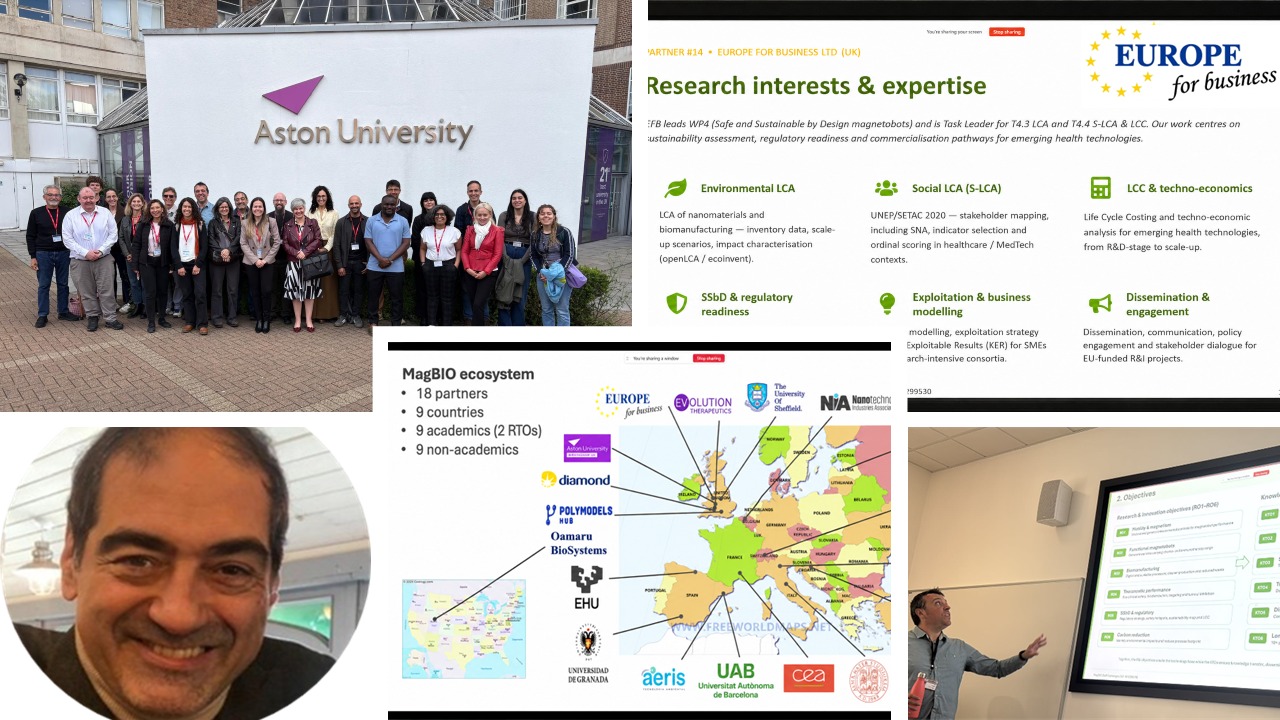
Aston University, UK, 4–5 June 2026
There are some research projects that begin with a neat administrative exercise: names around a table, work packages on a screen, reporting rules carefully explained. The MagBIO project, Living magnetobots for targeted theranostics to tackle metastatic solid tumours, launched this week 4th-5th June at Aston University with all of this in place. But beneath the familiar structure of a kick-off meeting sits a much more ambitious scientific question: can living microorganisms be engineered, guided and assessed safely enough to become a future platform for targeted cancer diagnosis and therapy?
Funded under the Marie Skłodowska-Curie Actions Staff Exchanges programme, MagBIO brings together 18 partners from Europe and the USA to explore a new class of living “magnetobots” inspired by magnetotactic bacteria. These microorganisms naturally produce magnetic structures and can move in response to magnetic fields. MagBIO will investigate how these properties could be used to support targeted cancer diagnosis and therapy, while considering safety, sustainability and regulatory questions from the start.
Europe for Business Ltd (EFB), based in the UK, will play a central role in the project. EFB leads WP4, focused on Safe and Sustainable by Design magnetobots, and is responsible for work on Life Cycle Assessment, Social Life Cycle Assessment and Life Cycle Costing helping the consortium examine the environmental, social and economic dimensions of the emerging technology as it develops.
Leonardo Piccinetti, CEO of Europe for Business and EFB Lead Researcher for MagBIO, was at the kick-off meeting presenting EFB’s role in the consortium, including its contribution to sustainability assessment, regulatory readiness, exploitation and stakeholder engagement.
“For EFB, MagBIO is precisely the kind of project where sustainability and exploitation need to be part of the scientific conversation from the beginning,” said Leonardo Piccinetti. “The technology is highly ambitious, but ambition has to be matched with evidence. Our role is to help the consortium ask the practical questions early: what data will be needed, what the environmental and social implications may be, how the costs might look at scale, and what will be needed for future regulatory and market readiness.”
EFB will also host secondees in Manchester, where activities will focus on desk-based research, modelling, data analysis, stakeholder engagement and joint outputs linked to WP4. The secondments will help connect scientific development with the evidence needed for responsible assessment, future exploitation and informed decision-making.
With the kick-off meeting complete, MagBIO now moves into implementation, beginning a four-year programme of research, training and knowledge exchange across academia, industry and specialist support organisations.
MagBIO, Living magnetobots for targeted theranostics to tackle metastatic solid tumours, is funded under the Horizon Europe Marie Skłodowska-Curie Actions Staff Exchanges programme. The project involves 18 partners across Europe and the USA.
2025 © Europe for Business (EFB) All Rights Reserved. | Powered By Webpristine Technology